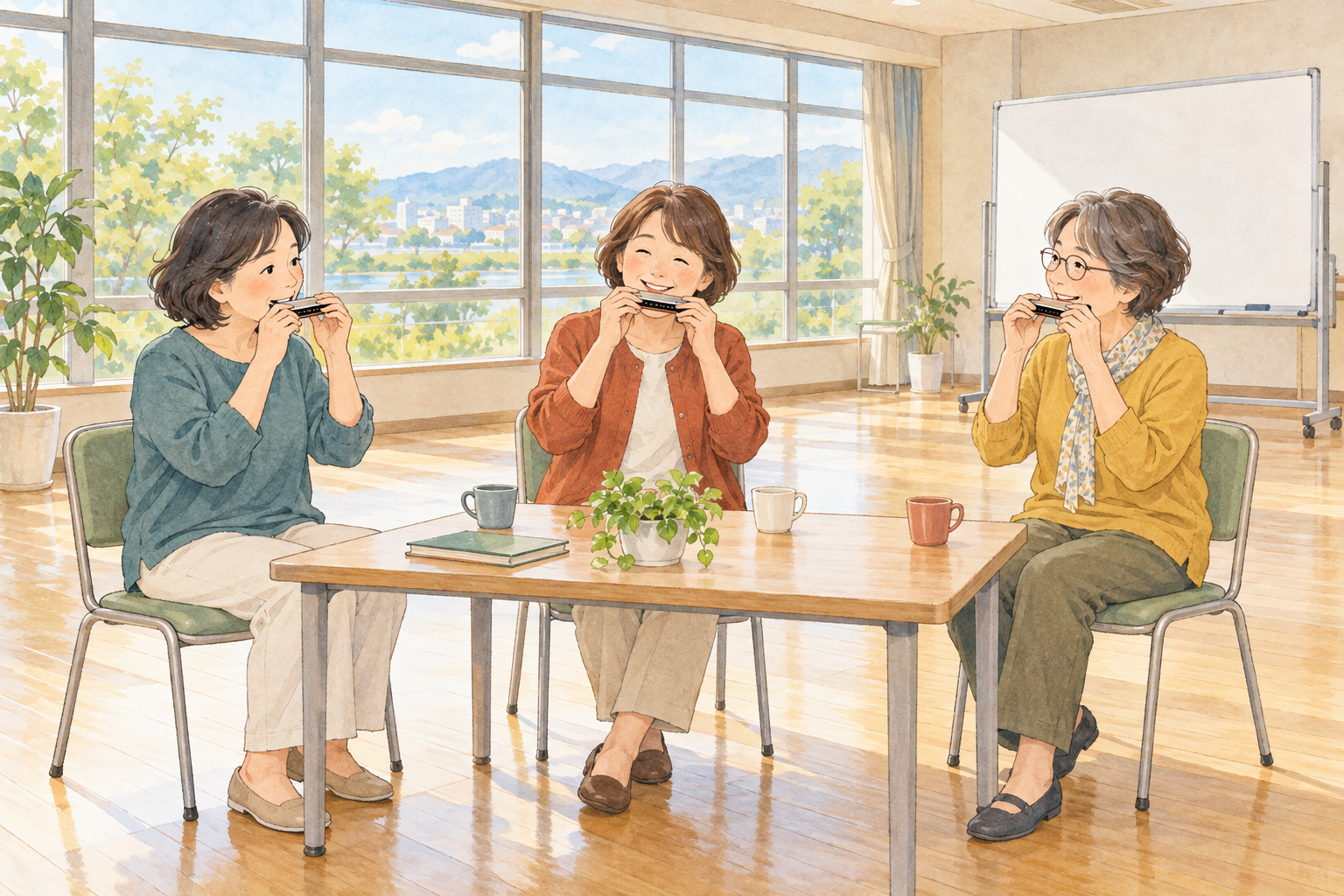
今回の記録と、文献の話を分けて読む
このページの「今回のレッスン」は、10月16日の板書・文字起こしと本人の訂正に基づいています。「文献から学ぶ」は、各節に示した資料をもとにした自校の解説です。歴史の説明を、この日にすべて教わった内容としては扱いません。
日本語/Englishボタンで切り替わるのは、このページに用意した解説です。出典欄の「英語の原典を見る」は外部の原資料を開きます。外部サイトを翻訳した画面ではありません。
Reading the lesson record and the literature separately
The lesson sections draw on the October 16 whiteboard, transcript and the teacher’s corrections. The literature sections are our own educational explanations based on the sources cited in each section. They are not a claim that every historical topic was covered in this lesson.
The Japanese / English buttons switch between the versions written for this page. “Read the English original” opens an external source. It does not display an automatically translated external website.
今回のレッスンThe actual lesson
この日の入口:Cのハーモニカで、Gを中心に
楽器のキーはC、今回のブルースの中心はG。先生はGを「王様」として説明しました。シャッフルの拍を共有し、ソの吸う音を確かめながら、12小節の枠組みでやり取りします。
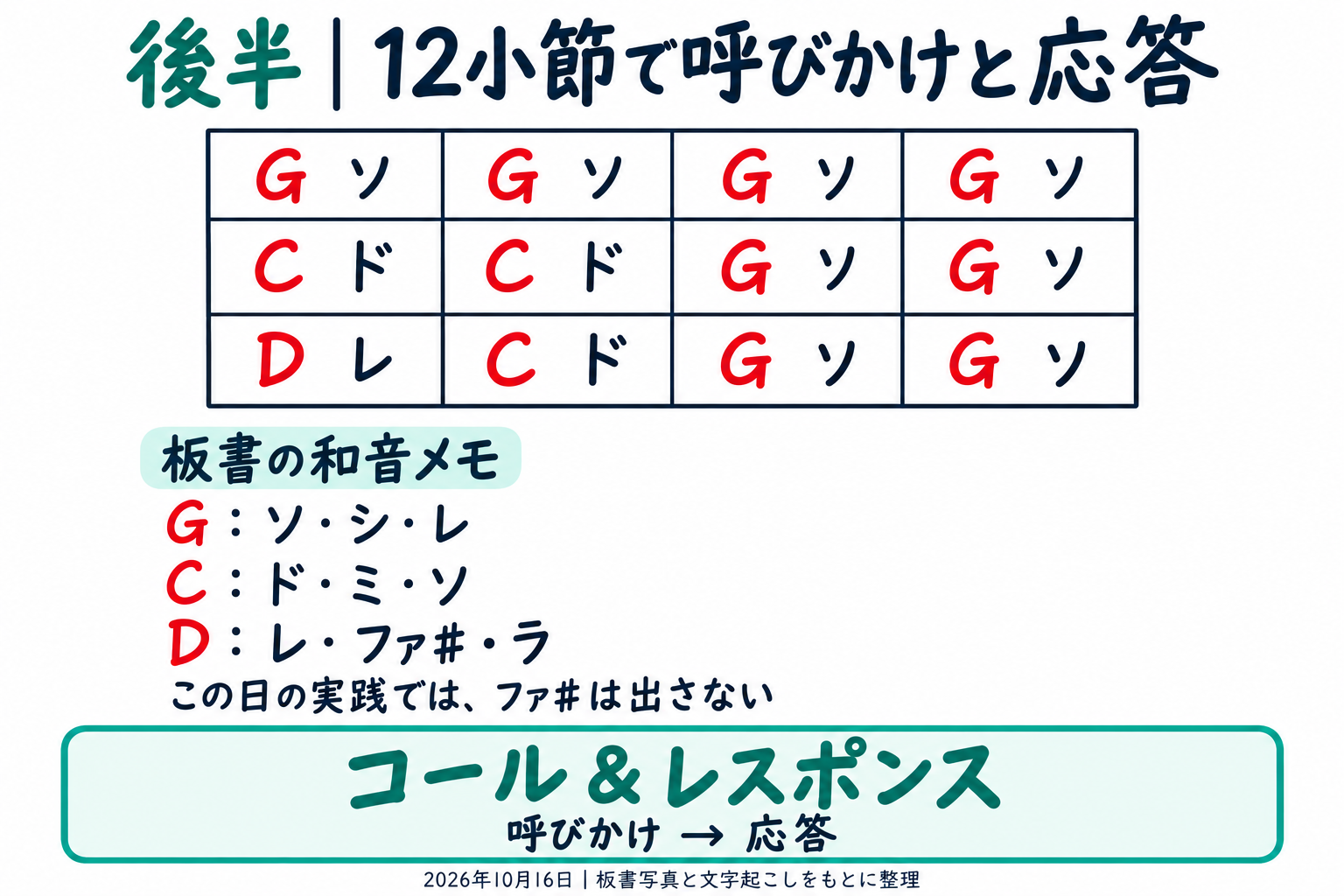
板書に残ったコードの並びは、次のとおりです。これはこの日のレッスンの記録で、文献に出てくる進行を当てはめ直したものではありません。
The lesson’s starting point: a C harmonica, with G at the centre
The instrument is a C harmonica; the blues played in this lesson is centred on G. The teacher described G as the “king”. Learners shared the shuffle pulse, worked on a clear drawn G, and exchanged musical phrases within a twelve-bar framework.
The chord sequence below comes from this lesson’s whiteboard. It has not been replaced with a progression taken from a textbook.
文献から学ぶ|歴史From the literature | History
ブルースは、暮らしと声の中から育ったThe blues grew from lived experience and the human voice
米国議会図書館は、ブルースを19世紀末の米国南部でアフリカ系アメリカ人が生み、歌った世俗音楽として説明しています。20世紀に演奏者が北へ移動する中で、新たな様式と聴き手が育ちました。
その背景には、奴隷制下とその後の暮らし、西アフリカ由来の音楽文化、フィールドハラーやリングシャウト、宗教的な歌などの長い蓄積があります。一人の発明者や一つの年だけに起源を決められるものではありません。
この歴史を知ることと、今日の演奏を上手にすることは別の学びです。まず人の声の抑揚や、相手に届く呼びかけとして聴いてみると、この日の「音で会話する」練習への入口になります。最後の聴き方は、このページからの提案です。
The Library of Congress describes the blues as secular music created and sung by African Americans in the rural South in the late nineteenth century. Migration north in the twentieth century helped bring new styles and audiences.
Its background includes life under and after slavery, West African musical practices, field hollers, ring shouts and sacred song. These strands developed over time; the blues cannot be assigned to a single inventor or year.
Historical understanding and instrumental skill are different kinds of learning. As our listening suggestion, notice the inflection of the human voice and how a musical phrase addresses another person. That offers one way into this lesson’s musical conversation.
文献から学ぶ|形式From the literature | Form
12小節は、相手と場所を共有する枠組みTwelve bars provide a shared musical map
よく使われる12小節の型は、中心の和音I、そこから動くIV、緊張を作るVを組み合わせます。Gを中心にした場合はG・C・Dが対応します。NYUの教材は、2小節目をIまたはIV、最終小節をIまたはVとする違いも示しています。12小節だけがブルースの形ではなく、8小節の例もあります。
下は文献の型をGで示した一般的な一例です。4拍子・各マス1小節。今回の板書の最後はGですが、この例は次の周回へ向かうD7で終わります。
これは伴奏のコード進行で、Cのハーモニカで各コードを全部同時に鳴らす課題ではありません。「7」は和音の種類を表す記号で、小節の数ではありません。まず変わる場所を聴き、同じ12小節のどこにいるかを相手と共有します。
A common twelve-bar scheme combines the tonic I, subdominant IV and dominant V. In G, these correspond to G, C and D. NYU’s anthology allows I or IV in bar two and I or V in the last bar, and also includes an eight-bar example. Twelve bars are not the only blues form.
This is one general example, shown in G, with one 4/4 bar per cell. The lesson whiteboard ends on G; this example ends on D7 to lead into the next chorus.
These are accompaniment chords, not an assignment to sound every chord simultaneously on a C harmonica. The “7” names a chord type, not a number of bars. Our practical focus is to hear the changes and share your place in the form.
文献から学ぶ|リズムFrom the literature | Rhythm
シャッフルは、拍の内側の進み方Shuffle concerns the motion inside the beat
Berkleeの解説は、シャッフルを通常、8分音符の3連系のフィールに基づくものとしています。均等に二つへ割るリズムとは、拍の中の長短の感じが異なります。
入門では「長い・短い」を2対1ほどと考えるとつかみやすいものの、これは理解のための近似です。すべての演奏が厳密な同じ比率になる、と決めつけません。実際のフィールは音を聴いて確かめます。
この日の復習では、カウントを聴いてから入り、相手が刻むシャッフルを受け取ることが大切でした。速いフレーズを増やす前に、拍を共有できているかを生録で振り返ってみてください。これは聴き直し方の提案です。
Berklee describes a shuffle as usually based on an eighth-note triplet feel. The long–short motion inside a beat differs from dividing it into two equal parts.
A roughly two-to-one long–short model can help a beginner understand the idea. It is an introductory approximation, not a claim that every performance uses an identical mathematical ratio. Listen to the actual feel.
In this lesson, learners listened to the count-in and shared the shuffle pulse. Our review suggestion is to notice that shared pulse before trying to add faster phrases. The excerpts do not have a verified BPM.
文献から学ぶ|やり取りFrom the literature | Musical exchange
コール&レスポンスは、同じ音でも違う音でも返せるAn answer may repeat a call or change it
Smithsonianの教材は、ある奏者のフレーズに、別の奏者が同じ、または違うフレーズで返すやり取りを説明しています。歌への応答をハーモニカなどの楽器が担う例も示されています。
この日の先生の呼びかけと、生徒が音を返す練習は、そのやり取りを体験する場面でした。決まった曲の正解を追うときとは、耳の向け先が少し変わります。
参考練習の提案:短く呼びかけ、相手の番を空け、返ってきた音を最後まで聴く。音を詰めるより、相手に渡す間を作ってみます。この提案を、録音で実施された課題や新しい宿題とは扱いません。
Smithsonian’s teaching guide describes a musician’s phrase being answered with the same or a different phrase. It also identifies instruments, especially harmonica, answering a singer.
The teacher’s calls and the learners’ answers offered a way to experience that exchange in this lesson. Listening to another player differs from following a fixed melodic answer.
Optional practice suggestion: make a short call, leave space for a partner, and listen through the answer. This is our suggestion, not a newly assigned homework task or a claim about an exact exercise completed in the recording.
文献から学ぶ|ハーモニカFrom the literature | Harmonica
C調でGを吹く、セカンドポジションSecond position: playing in G on a C harmonica
Steve Bakerは、C調ハーモニカの吹く側のCの和音に対し、吸う側のG7を中心に演奏する使い方を、クロスハープ/セカンドポジションと説明しています。G7の音はソ・シ・レ・ファ。楽器名のCと、曲の中心Gが異なっていても矛盾しません。
これは標準的な10ホールズの音配列を前提にした文献の補足です。今回の復習では穴番号の表を新しく増やさず、先生が示した響きを聴き、ソの吸う音を確かめる流れを優先します。
低い吸音が出しにくいとき、強く吸い込むだけで解決しようとしないことも大切です。HOHNERのFAQは、口や喉の形と、穏やかな呼吸に注意を向けています。生録のお手本と自分の響きを聴き比べることへ戻りましょう。
Steve Baker explains cross harp, or second position, as centring a C harmonica on its draw chord G7 rather than its blow chord C. G7 contains G, B, D and F. The instrument key C and the musical centre G therefore need not match.
This is background for a normally tuned ten-hole diatonic harmonica. We do not add a new hole-number chart to the lesson: the review remains focused on hearing the teacher’s sound and producing a clear drawn G.
For low draw notes, simply sucking harder is not the answer. HOHNER’s FAQ discusses mouth and throat shape and gentle breathing. Return to comparing your sound with the demonstration.
文献から学ぶ|音の表情From the literature | Expressive pitch
ブルーノートは、響きに表情を作る手がかりBlue notes offer another kind of expression
Gを中心にした場合、BakerはFをブルーノートとして説明し、ベンドによってB♭やD♭も得られることを挙げています。単に音を多く足すためではなく、響きの違いを聴くための補助知識です。
ここでのB♭・D♭・Fは文献による補足で、この日に新しく指定された宿題ではありません。板書のDの和音メモに出るファ♯とも目的を分けて読みます。板書の音をそのまますべて吹く指示へ変えないでください。
ベンドを急いで増やすより、まず出せる短い音を相手へ返し、その音がどう聞こえるかを聴いてみる。少ない音でもやり取りを作れるか、というのがこのページからの復習提案です。
In G, Baker identifies F as a blue note and describes bending to obtain B-flat and D-flat. This offers background for listening to differences in sound, rather than a requirement to add more notes.
These pitches are literature-based context, not new homework from this lesson. They serve a different purpose from the F-sharp in the whiteboard’s D-chord reminder. Do not turn every chord note on the board into an instruction to play it.
Our review suggestion is to answer with a short sound you can already make and listen to its effect, instead of rushing to add bends. Explore whether a small set of sounds can sustain a musical exchange.
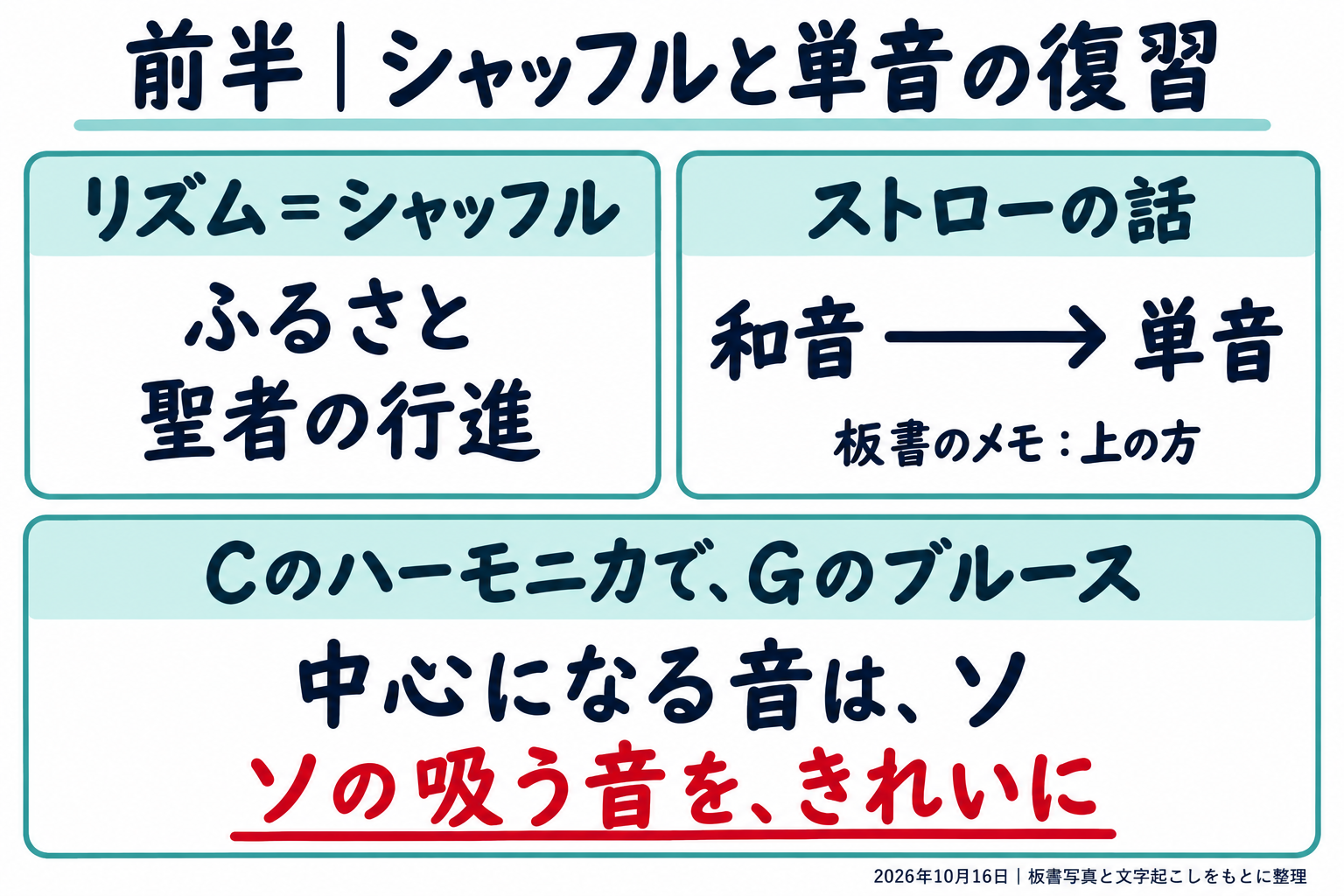
当日の板書を、2枚で振り返るTwo diagrams from the lesson whiteboard
原写真と文字起こしを照合した清書図です。不鮮明な鍵盤の線や数字の対応は補っていません。
These cleaned diagrams were checked against the original photograph and transcript. Unclear keyboard lines and number correspondences have not been reconstructed.
前半:シャッフルと単音の復習Part one: shuffle and single-note review
後半:12小節で呼びかけと応答Part two: call and response in twelve bars
この日の音で、復習するReview with recordings from this lesson
本人が選び、公開を承認した4本の生録です。説明や参加者の声が入ることがあります。新しく録り直したお手本や、伴奏だけの音源ではありません。
音量・速度・ピッチは変更していません。BPMは未確認です。短い抜粋のため、ループの境目が12小節の区切りと一致するとは限りません。自動再生はせず、再生・停止・途中への移動を自分で操作できます。
These four excerpts were selected and approved for publication by the teacher. They may include spoken instruction and participants’ voices. They are live lesson excerpts, not newly recorded demonstrations or backing-only tracks.
Volume, speed and pitch have not been changed. The BPM has not been verified. A short excerpt’s loop boundary may not coincide with a complete twelve-bar cycle. Playback is manual: you can play, pause and seek.
Gブルースの実演①Blues in G: demonstration 1
10月16日の生録・A2・25秒October 16 lesson excerpt · A2 · 25 seconds
音源を保存Download audioGブルースのまとめ実演Blues in G: closing demonstration
10月16日の生録・A3・35秒October 16 lesson excerpt · A3 · 35 seconds
音源を保存Download audio呼びかけと応答①Call and response 1
10月16日の生録・B1・30秒October 16 lesson excerpt · B1 · 30 seconds
音源を保存Download audio呼びかけと応答②Call and response 2
10月16日の生録・B2・30秒October 16 lesson excerpt · B2 · 30 seconds
音源を保存Download audio音を返す前に、相手を聴く
先生の短いフレーズを聴いて、次に自分の音を返す。決まった旋律を再現する曲の練習から、相手の出した音を受け取る練習へ、一歩進みました。まず生録で、この日の音の受け渡しを思い出してみてください。
この日に明示された宿題は、ソの吸う音をきれいに出せるように練習することです。毎日の回数や提出期限は追加していません。水の量も一律の目標にはしていません。
Listen before you answer
Listen to the teacher’s short phrase, then answer with your own sound. The lesson moved beyond reproducing a fixed melody towards responding to another player. Start by revisiting the exchanges in the lesson excerpts.
The explicitly stated homework was to practise producing a clear drawn G. No new daily repetition count or submission deadline has been added here. No universal water-intake target has been introduced.